Fehi Madharusa
The Fehi Madharusa background and other details about the program
Fehi Madharusa Framework
WHOLE SCHOOL APPROACH
In order to achieve the above goals, the Fehi Madharusa Framework outlines criteria and targets that a school must meet. Schools are provided with a framework to follow and targets to achieve in order to be recognized for their efforts with a bronze-to-gold awarded seal.
Becoming a Fehi Madharusa is a long-term journey that requires constant evolution and innovation. To begin this journey however, it is first important for each school to know the steps necessary to meet their target. The school will need to carry out a baseline survey to understand where to start and what are realistic targets. This will inform the action plan which will need to encompass the Fehi Madharusa program’s four broad themes:
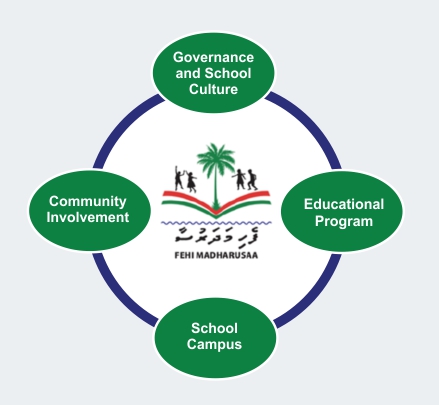
Governance and School Culture
- Defining what environmental stewardship and sustainability means in the school community to create a shared culture between staff, students and parents of values and beliefs about the importance of protecting our environment and making more sustainable choices for a healthier and fairer future.
- Expressing these beliefs in the school vision, mission and strategic plans.
- Involving everyone: students and their parents, teachers, administrators, janitors, building operators, office support staff, and local community partners.
- Creating a team of environmental stewards to champion the program with representatives from all sectors of the school (students and adults).
- Creating spaces for students to share their concerns, solutions and creative ideas.
- School principals championing this mission as they will be the natural school culture setters. However, everyone in the school community has the power to become an environmental and ocean champion through dedication, effort and, of course, action.
Educational Program
- Aligning the curriculum with national government plans that will influence the skills required of future school leavers.
- Including and extending the teaching of environmental stewardship and sustainability beyond science or social science and into vocational skills and future career choices. Lessons can be adapted to include the interconnectedness of what is learnt and the environment, our actions and our futures.
- Including learning outside the classroom and with partners in the community, inviting experts and teaching resourcefulness (where to find the information needed).
- Teaching critical and creative thinking skills through cooperative learning and real-life projects that prepare students for the low carbon careers of the near-future (learning about, through and from action – students can design group projects, attempt start-ups, partner with outside experts and reflect on their learnings).
School Campus
- Making the school grounds and operations a model of the teachings (efficient use of resources such as water, energy and paper, sustainable purchasing choices, segregated waste disposal and composting, planting etc.)
- Using the school campus as a hand-on teaching tool, where students can create, implement and witness sustainable systems.
- Showcasing efforts with a highly visible noticeboard of the school Fehi Team, mission, action plan and progress.
Community Involvement
- Building partnerships to spread the message, share experiences, knowledge and diverse perspectives (campus tours, beach clean ups, start-up projects) with individuals on the island as well as businesses, NGOs and other groups.
- Aligning projects at school with the needs of the island community, making
them relevant and valid to achieve better buy-in.
A whole school approach towards environmental stewardship and sustainability involves integrating these values into organizational and educational practices at every level of the school. Based on extensive research and experience the benefits of working with this approach, when considering attitudes towards sustainability, are:
- All involved have a greater sense of belonging in the school.
- Students have meaningful hands-on opportunities for learning.
- Teachers have new professional development opportunities.
- Schools can achieve significant reductions to their ecological footprint.
- Schools save money through efficient use of resources.
- School campuses become more beautiful and greener.4
SYSTEMS MODELS
Originally introduced as an ‘Iceberg Diagram’ by Donella Meadows to demonstrate the power of assumptions, the Iceberg Model has been developed as a simple tool to demonstrate and discover the complex and levelled causes of behavior and systems.
In the Fehi Madharusa Framework, we have presented a version of system thinking as a Barrier Reef Island, to represent different levels of engagement toward environmentally conscious systemic change in school communities.
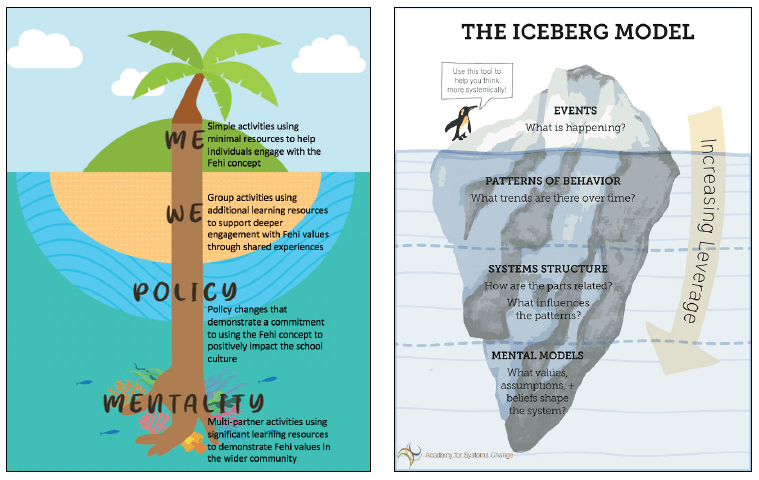
The whole school activities framework within Fehi Madharusa includes activities that have varying degrees of impact, complexity, and depth. The whole school activities are organized according to the Barrier Reef Island Model as described in the table below:
Island Layer
Depth of activity and impact
Me
Simple, low resource activities that often have a surface-level impact on individual understanding of the Fehi concept.
We
Activities which require a group of participants interacting, additional resources or preparation may be necessary, and these activities potentially can lead to a deeper learning of Fehi values through shared experiences.
Policy
Changes at the school governance level connected with school policies and procedures. These changes demonstrate school commitment to the Fehi framework and have the potential to impact and enhance school culture.
Mentality
Complex, often resource-intensive, multi-partner activities that require deeper levels of engagement and greater commitment to implement. Activities at this level demonstrate Fehi values at a wider school and island community level.